


Where Do Organizational Decisions Come From?


Where Do Organizational Decisions Come From?
Why can two leaders examine the same evidence, work under the same policy, and still reach very different decisions?
This is not an abstract concern.
An organisation may have experienced professionals, detailed procedures, governance committees, extensive data, and increasingly capable AI systems. Yet a consequential decision can still feel disconnected from reality, responsibility, or the people who will carry its effects.
The usual explanation is that either the individual failed or the system failed.
That division is too simple.
Human judgment is shaped by experience, values, assumptions, fear, identity, professional roles, and perceived responsibility. It is also shaped by incentives, authority structures, organisational norms, available information, time pressure, technologies, and whether people are genuinely permitted to question a preferred course of action.
A serious account of organisational decision-making must therefore examine both the person who judges and the conditions within which judgment becomes possible.
Information Alone Does Not Determine Decision Quality
Research on decision-making has long challenged the assumption that human beings evaluate every option with complete information and unlimited analytical capacity.
Herbert Simon’s work on bounded rationality established that decisions are made within cognitive and environmental limits. People work with incomplete information, finite attention, and practical constraints rather than perfect rationality (Simon, 1955).
Tversky and Kahneman later demonstrated how judgment under uncertainty can be shaped by heuristics and systematic biases (Tversky & Kahneman, 1974).
These research traditions support a measured conclusion: greater intelligence, more information, or better analytical tools do not automatically produce responsible judgment.
Leadership research adds another layer. Work on authentic leadership has examined the relevance of self-awareness, internalised values, balanced information processing, and relational transparency (Avolio & Gardner, 2005). Ethical leadership research has also considered how individual conduct and situational influences contribute to the ethical behaviour observed within organisations (Brown & Treviño, 2006).
The institutional environment matters as well. Edmondson’s study of 51 work teams found that psychological safety was associated with learning behaviour. When people believe that interpersonal risk-taking is possible, they may be more willing to raise concerns, discuss errors, and contribute information that would otherwise remain hidden (Edmondson, 1999).
Taken together, these research streams suggest that organisational decisions cannot be understood through individual character or system design alone.
Good People or Good Systems?
One view places responsibility primarily within the individual.
From this perspective, organisations need more ethical, self-aware, and courageous decision-makers. If leaders possess the right values, responsible decisions should follow.
The limitation is clear. Even a reflective person can be constrained by distorted incentives, restricted information, punitive authority structures, unrealistic targets, or a culture in which disagreement carries professional consequences.
The opposing view places responsibility primarily within systems.
According to this position, behaviour will improve when organisations design better incentives, controls, reporting structures, audits, and accountability mechanisms.
This view identifies an essential part of the problem. Yet systems do not interpret their own rules, recognise every emerging risk, or challenge their own assumptions. People design, operate, accept, resist, and revise them.
A system may formally permit dissent while informally rewarding silence. A leader may publicly endorse transparency while treating inconvenient questions as disloyalty. An AI governance policy may require human oversight while giving the human reviewer neither sufficient time nor meaningful authority to intervene.
The better unit of analysis is therefore the interaction between human judgment and institutional conditions.
The GRIT™ Proposition: Examining the Origin of Judgment
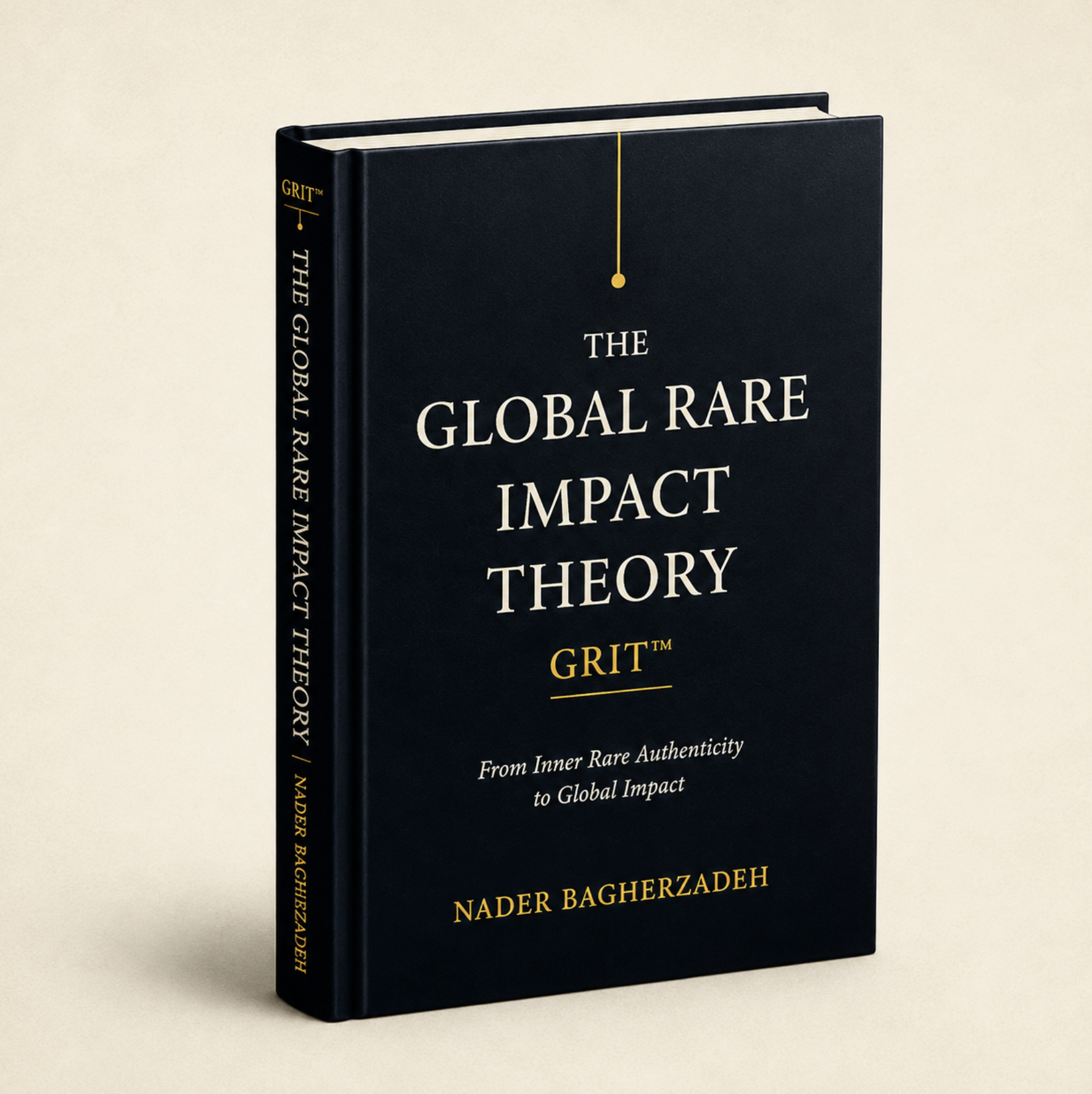
The Global Rare Impact Theory (GRIT™) is a developing, transdisciplinary conceptual framework. It proposes that responsible impact may depend partly on the quality of awareness, judgment, and responsibility from which action emerges.
Within GRIT™, Inner Rare Authenticity™ refers to the developing alignment among awareness, values, lived experience, and responsible contribution. It is not treated as unrestricted self-expression or personal preference.
GRIT™ does not claim that individual awareness can replace sound governance. It also does not assume that institutional reform can remove the need for human responsibility.
Instead, it introduces an earlier question into decision analysis:
Before asking whether a decision is effective, rational, or ethical, can we examine where the judgment behind it is coming from?
Within GRIT™, Awareness of Decision Origin is a proposed construct referring to a person’s capacity to recognise the forces participating in the formation of judgment.
These forces may include:
examined values and a genuine sense of responsibility;
fear of failure or exclusion;
identification with a professional role;
pressure to protect reputation;
financial or organisational incentives;
expectations from authority;
habitual interpretations of success;
an AI-generated recommendation that has acquired unearned authority.
Recognising these influences does not eliminate uncertainty or bias. It may, however, make the formation of a decision more open to examination.
What Is Decision Coherence?
GRIT™ proposes Decision Coherence as the degree of alignment among:
the reality a decision-maker is willing to acknowledge;
the values being applied;
the action being chosen;
the responsibility accepted for foreseeable consequences;
and the behaviour through which the decision becomes observable.
A coherent decision is not necessarily a comfortable or successful decision. It can still produce an uncertain outcome.
Coherence also does not mean remaining loyal to an initial belief. New evidence may require revision. In some situations, changing course is more coherent than defending a decision whose assumptions no longer hold.
Decision Coherence should therefore be distinguished from confidence, consistency, decision speed, and decision quality.
A person can be highly confident and poorly informed.
A team can remain consistent while avoiding contradictory evidence.
An organisation can decide quickly while leaving responsibility unclear.
A decision can produce a favourable result despite a deeply incoherent process.
The GRIT™ proposition is more limited: awareness of decision origin may help people examine the relationship among reality, values, action, and responsibility. This proposition requires future empirical testing.
A Practical Decision Coherence Review
The following five-question review is a practical application proposed within this article. It is not a validated assessment instrument.
It can be used before approving a consequential organisational decision.
. Reality
What do we know, what are we assuming, and what remains uncertain?
Separate available evidence from interpretation. Identify which claims are well supported and which depend on forecasts, incomplete data, or organisational narratives.
. Origin
What is shaping our judgment at this moment?
Consider values, experience, fear, urgency, financial incentives, reputation, loyalty, professional identity, and pressure from authority. The purpose is not to remove every influence. It is to make relevant influences discussable.
. Conditions
Who can question this decision without disproportionate personal cost?
Examine whose knowledge is present, whose perspective is absent, and whether formal permission to speak is supported by actual organisational behaviour.
. Responsibility
Who receives the benefit, who carries the risk, and who remains accountable if the assumptions are wrong?
Responsibility becomes weak when benefits are concentrated while consequences are transferred to employees, customers, communities, or future decision-makers.
. Observable Follow-Through
What behaviour would demonstrate that the stated values genuinely influenced the decision?
Identify one visible action, one responsible owner, and one condition that would trigger review or reversal.
This process does not guarantee the correct answer. Its purpose is to make the architecture of judgment more visible before the consequences become difficult to reverse.
A Hypothetical Organizational Example
Consider an organization deciding whether to reduce a customer-support team after introducing an AI-assisted service system.
The financial analysis predicts lower operating costs. Initial performance data suggest that the AI system can manage a significant proportion of routine enquiries.
A narrow decision process might ask:
How much money will the organization save?
How quickly can the change be implemented?
Does the system meet the required performance threshold?
A Decision Coherence review introduces additional questions:
Which types of customer difficulty are missing from the average performance measure?
Are employees able to report failures without appearing resistant to technological change?
Is the decision being shaped by reliable evidence or by pressure to demonstrate rapid AI adoption?
Who will carry responsibility when a complex case is mishandled?
What evidence would cause the organization to pause or revise the reduction plan?
GRIT™ does not determine whether the organization should retain or reduce the team. It proposes a way to examine the human and institutional origins shaping that decision.
Human Judgment in AI-Enabled Organisations
Artificial intelligence increases the speed and scale at which organisations can classify information, generate options, forecast outcomes, and automate action.
This expansion of capability creates a governance question:
What quality of human judgment guides the use of that capability?
The NIST Artificial Intelligence Risk Management Framework emphasises the management of AI risks to individuals, organisations, and society, including the importance of accountable organisational practices and governing structures (NIST, 2023).
GRIT™ adds a conceptual human layer to this discussion.
An organisation may establish technical controls, human-oversight procedures, and formal accountability while leaving several questions unresolved:
Does the human reviewer understand the limits of the system?
Can that person challenge the recommendation?
Is intervention genuinely supported when it delays a commercial objective?
Who decides which consequences count as significant?
From where are those human judgments being made?
Responsible AI governance requires technical competence and institutional safeguards. GRIT™ proposes that it may also require greater awareness of the human sources from which interpretation, approval, and intervention emerge.
What Is Established, What Is Proposed, and What Remains Unknown?
Clear boundaries are necessary if GRIT™ is to become a credible research programme.
Findings supported by established research
Existing studies and theories have shown that human rationality is bounded, judgment can be influenced by heuristics, leadership has individual and situational dimensions, and psychologically safer team conditions can support learning behaviour.
GRIT™ theoretical propositions
GRIT™ proposes that Awareness of Decision Origin may contribute to Decision Coherence, and that Decision Coherence may help connect internal awareness with responsible organisational action.
These relationships remain theoretical.
Questions requiring empirical research
Future studies should examine:
Can Awareness of Decision Origin be operationalised and measured reliably?
Does it predict Decision Coherence across different organisational settings?
How do incentives, authority, psychological safety, and professional norms influence this relationship?
Does Decision Coherence predict observable ethical or organisational outcomes?
How do cultural differences affect understandings of authenticity and responsibility?
Under what conditions would empirical evidence weaken or falsify GRIT™ propositions?
How does human judgment quality affect decisions made with AI systems?
GRIT™ is currently a conceptual and practice-informed framework. It should not be described as empirically validated, universally established, therapeutic, or diagnostic.
From This Article to the Book
This article examines one part of a broader architecture developed in the book:
The Global Rare Impact Theory (GRIT™): From Inner Rare Authenticity to Global Impact
Written by Nader Bagherzadeh, the book develops the proposed movement from inner awareness and the Rare Inner Code™ toward relationships, work, ethical leadership, organisational systems, AI governance, responsible impact, and longer-term social questions.
Readers interested in the themes examined here may begin with:
Chapters 1–4 for Inner Rare Authenticity™, the Rare Inner Code™, and the R.A.R.E™ architecture;
Chapters 6–7 for work, leadership, organisations, and systems;
Chapter 8 for humanity, technology, and AI;
Chapter 11 for leadership and governance in the age of AI.
The book was published on 10 August 2026 and is available in Kindle and paperback editions.
The Global Rare Impact Theory (GRIT™) From Inner Rare Authenticity to Global Impact
THE BOOK IS NOW AVAILABLE
Kindle — $12.99 USD
Paperback — $29.99 USD
BUY ON AMAZONReaders may also:
An Open Research Question
The practical and theoretical challenge is not to choose between personal responsibility and institutional responsibility.
It is to understand their interaction.
How should future research examine the relationship between the inner sources of human judgment and the organisational conditions that shape whether responsible action becomes possible?
Relevant literature, methodological criticism, competing interpretations, and empirical collaboration are welcome.
Academic dialogue begins with questions—not conclusions.
References
Avolio, B. J., & Gardner, W. L. (2005). Authentic leadership development: Getting to the root of positive forms of leadership. The Leadership Quarterly, 16(3), 315–338. https://doi.org/10.1016/j.leaqua.2005.03.001
Bagherzadeh, N. (2026). The Global Rare Impact Theory (GRIT): From Inner Rare Authenticity to Global Impact.
https://papers.ssrn.com/sol3/papers.cfm?abstract_id=5796642
Brown, M. E., & Treviño, L. K. (2006). Ethical leadership: A review and future directions. The Leadership Quarterly, 17(6), 595–616. https://doi.org/10.1016/j.leaqua.2006.10.004
Edmondson, A. (1999). Psychological safety and learning behavior in work teams. Administrative Science Quarterly, 44(2), 350–383. https://doi.org/10.2307/2666999
National Institute of Standards and Technology. (2023). Artificial Intelligence Risk Management Framework (AI RMF 1.0). NIST AI 100-1. https://doi.org/10.6028/NIST.AI.100-1
Simon, H. A. (1955). A behavioral model of rational choice. The Quarterly Journal of Economics, 69(1), 99–118. https://doi.org/10.2307/1884852
Tversky, A., & Kahneman, D. (1974). Judgment under uncertainty: Heuristics and biases. Science, 185(4157), 1124–1131. https://doi.org/10.1126/science.185.4157.1124
Research-status statement
This is a conceptual and practice-oriented article within the developing GRIT™ Global Academic Program. It distinguishes established research findings from GRIT™ theoretical propositions and future empirical questions.
Author
